
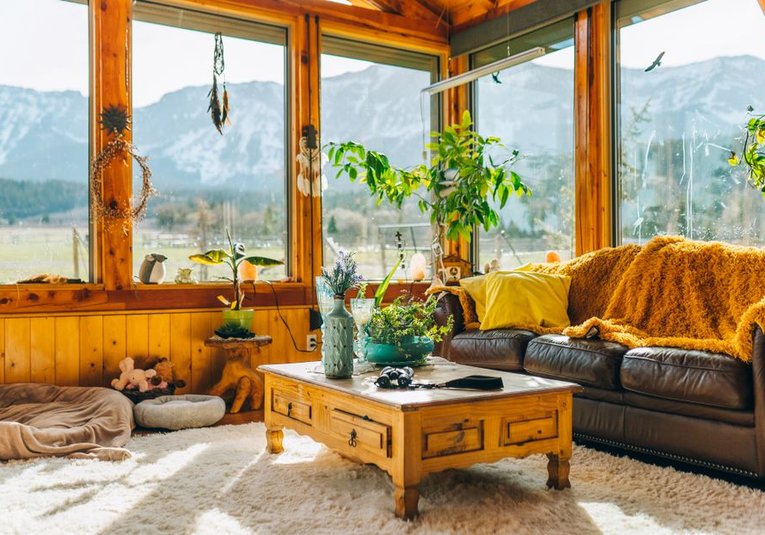
 Vaulted ceilings and wall-to-wall windows are glorious, until you try to have a conversation or stay warm.
Hearth as Anchor: Why the Fireplace Still Organizes a Mountain Home
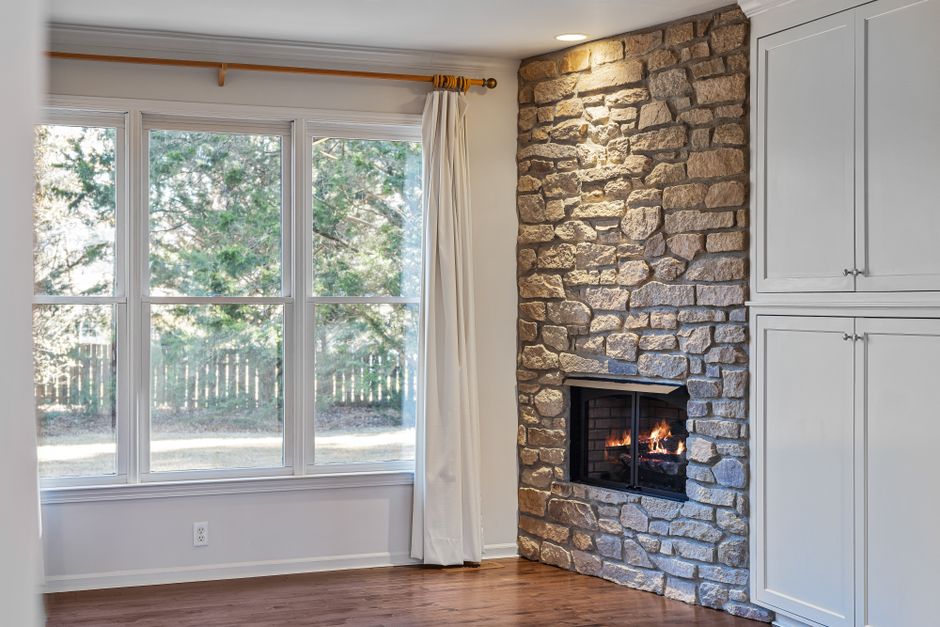
No element says mountain home quite like the fireplace, and no element is more often done badly. The problem is rarely the fire itself. It is that the fireplace gets treated as a decorative object to be placed on a wall rather than as the organizing element of the room — the thing that determines where people sit, how the space is zoned, and how the house feels on a cold night.
Think about what a hearth actually does. It gives a large, open room a center. Mountain living rooms tend to be big, with high ceilings and a wall of glass, and big rooms without an anchor feel like lobbies. A fireplace pulls furniture into a conversation cluster, gives the eye a destination, and provides warmth that is as much psychological as thermal. That is why it still matters even in a house with a perfectly good furnace.
Placement and Proportion
Where the fireplace goes determines how the room works. A fireplace on the same wall as the main view forces a choice between fire and mountain; a fireplace on an adjacent wall lets you enjoy both, angled so that seating faces the hearth with the view off to one side. A freestanding or see-through fireplace can divide a large space into two zones without walls, which is often the most elegant solution in an open plan.
Proportion is where most fireplaces go wrong. A firebox that is too small for a tall stone surround looks lost; one that is too large overwhelms the room and throws more heat than you want. A common rule of thumb is that the firebox opening should relate to the scale of the room and the seating distance — roughly, you want to be able to feel the fire from where you sit, which usually means eight to twelve feet away, not thirty. If your room is enormous, consider a fireplace plus a secondary heat source rather than one gigantic hearth.
Materials should belong to the place. Local stone, in a size and color that matches what is actually on the site, almost always looks better than a shipped-in veneer that could be anywhere. A simple, well-proportioned stone surround with a substantial mantel will age better than an elaborate one that follows a trend. If you want a modern look, a plaster or concrete surround with a clean reveal can be beautiful — but it should still feel grounded, not thin.
Making It Work, Not Just Look Good
Wood-burning fireplaces are beloved and increasingly regulated, so check local air-quality rules before you commit. A high-efficiency wood insert or a EPA-certified stove gives you the atmosphere with far less smoke and more heat. Gas fireplaces offer convenience and clean operation, and modern direct-vent units look convincing. If you want the ritual of building a fire, a wood stove in a mountain home is hard to beat — it heats, it cooks, and it becomes the place everyone drifts toward.
Do not forget the practical details. A hearth needs somewhere to put wood, tools, and ash, ideally in a niche or adjacent closet rather than stacked on the floor. It needs a mantel at a height that works for the objects you actually own, and a surface that can take heat and soot. And it needs to be sited so that a fire can be lit without a gust from a nearby door sending smoke into the room — a real issue in tight, well-sealed mountain houses.
Get the hearth right and it becomes the memory people carry away from your house: the sound of a fire, the smell of wood, and the particular warmth of a room that has a center.